Multicultural Weddings
Christian-Hindu Wedding Vows and Ceremony Ideas
Sample Christian-Hindu ceremony outlines and original vow wording, with KJV readings and a respectful guide to the saptapadi, garland exchange and blessings.
A Christian-Hindu ceremony usually combines a few elements from each tradition, such as a scripture reading and exchange of vows from the Christian side and a garland exchange and the saptapadi (seven steps) from the Hindu side, around a shared welcome and blessing. Below you will find three sample ceremony outlines, original vow wording you can adapt, public-domain scripture readings, and notes on explaining Hindu rituals respectfully. Review your final script with your officiants.
Key takeaways
- Choose an outline first (blended, Christian-led with Hindu elements, or Hindu-led with Christian elements), then write vows that fit it.
- Ask your priest or pastor and your pandit what they will include; some will lead only parts of a blended ceremony, and some have specific requirements.
- The saptapadi can carry personal vows in English alongside the pandit's Sanskrit, if your pandit agrees.
- Choose readings that both families can hear comfortably, and explain each ritual in your program.
- Have any Hindi or Sanskrit wording checked by your pandit or a fluent speaker.

If you have not yet decided between one blended ceremony and two separate ones, read How to Plan a Hindu-Christian Wedding: Complete Guide first. This article is about the words and order of the ceremony itself.
Three sample ceremony outlines
These outlines are starting points, not required sequences. Practices vary by denomination, region, community, family and officiant, and some churches do not allow non-Christian rituals in the sanctuary. Bring your draft to your officiants and let them shape it.

Outline A: One blended ceremony with two officiants
Often 45 to 75 minutes, depending on how much of each tradition you include.
- Processional. Strings, piano or shehnai; parents and wedding party enter.
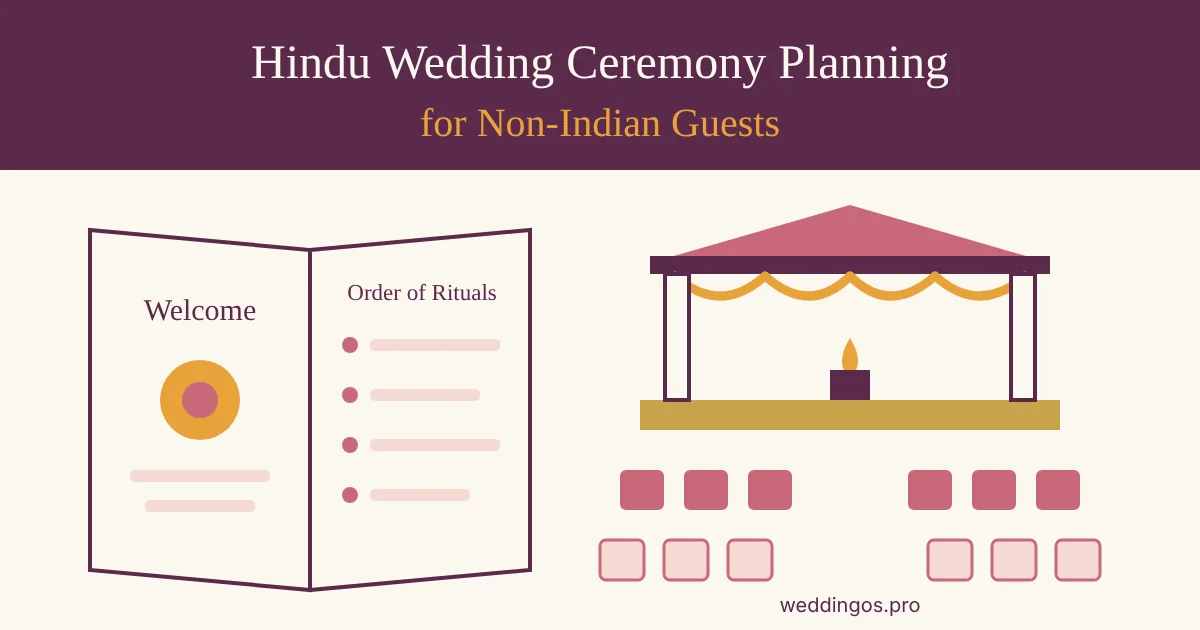
- Welcome from both officiants, explaining that two traditions are joining.
- Opening invocation. A brief Ganesh invocation by the pandit, often offered at the start of Hindu ceremonies to remove obstacles, followed by a Christian opening prayer. Some couples hold the Ganesh puja privately beforehand.
- Reading from scripture (see readings below).
- Varmala (वरमाला), the exchange of flower garlands, symbolizing acceptance of each other.
- Exchange of vows in the Christian style, spoken to each other.
- Ring exchange.
- Saptapadi (सप्तपदी), the seven steps, often taken around or toward the sacred fire, with the pandit's Sanskrit and your English vows for each step.
- Optional rituals, such as tying the mangalsutra (मंगलसूत्र) or applying sindoor (सिंदूर), if they hold meaning for you.
- Blessings from both officiants and from elders, sometimes called aashirvad (आशीर्वाद).
- Declaration and recessional.
Outline B: A Christian ceremony with Hindu elements
Useful when the ceremony takes place in a church or with a Christian officiant leading.
- Processional, with a dhol or Indian instrumental as guests are seated, if the church permits.
- Greeting and opening prayer.
- Readings, possibly including a reflection on the saptapadi read by a relative.
- Homily or message.
- Vows and ring exchange.
- Varmala, often placed after the vows or at the recessional, or held at the reception if the church prefers.
- Blessing, and a moment for elders from the Hindu family to bless the couple.
- Recessional.
Outline C: A Hindu ceremony with Christian elements
Useful when the pandit leads and a pastor, priest or family member takes part.
- Baraat and welcome of the groom's family, if part of your tradition.
- Ganesh puja and opening rituals as your pandit directs.
- Varmala.
- A Christian reading or prayer led by a pastor, priest or family member.
- Main Hindu rituals, such as the mangal phere (circling the fire) and saptapadi, as your pandit recommends.
- Personal vows in English and a ring exchange.
- Blessings from elders and a closing prayer.
For more on which Hindu rituals families often keep, shorten or explain, see How to Plan a Hindu-Christian Interfaith Wedding. For the Christian side, see Planning an Interfaith Christian Wedding.
Sample vow wording
These vows are original and free to adapt. Change anything that does not sound like you.
Shared vows (spoken by each partner)
I take you as my partner in marriage, joining my life and my family to yours. I promise to honor your faith as I hold my own, to listen when it is hard, and to celebrate what we share. In joy and in sorrow, in plenty and in want, in sickness and in health, I will love you, respect you and stand beside you, all the days of my life.
Vows that name both traditions
Today I stand with you before God, before the sacred fire, and before the families who raised us. From your family I have learned new prayers and new songs; I promise to keep learning. I will make a home where both our traditions are welcome at the table, where our differences make us curious instead of afraid, and where love is the first language we speak.
Short vows for a ring exchange
With this ring I promise you my faithfulness, my patience and my joy. Wear it as a sign that two families and two traditions are now one home.
Saptapadi vows in English
In many Hindu ceremonies, the couple takes seven steps together while the pandit recites Sanskrit verses. In English, the steps are commonly explained as blessings or promises for nourishment, strength, prosperity, happiness, family, health and lifelong friendship. Interpretations vary by tradition and family, so ask your pandit how they explain each step.

With your pandit's agreement, you might each say one short English line after each step. An original example:
- Nourishment: "With this first step, I promise to care for our home and for each other's daily needs."
- Strength: "With this second step, I promise to be your strength, and to let you be mine."
- Prosperity: "With this third step, I promise to share what we earn and to give generously."
- Happiness: "With this fourth step, I promise to seek joy with you and to honor both our families."
- Family: "With this fifth step, I promise to build a loving family, however it grows."
- Health and seasons: "With this sixth step, I promise to walk with you through every season of life."
- Friendship: "With this seventh step, I promise to be your best friend for the rest of my life."
Note that Hindi and Sanskrit terms in this article are given in Devanagari and common transliteration; have your pandit or a fluent speaker check any wording before it is printed.
Readings from scripture
Many interfaith couples choose passages about love and partnership that both families can hear comfortably. These are from the King James Version (KJV), which is in the public domain.
- 1 Corinthians 13:4-7 (KJV): "Charity suffereth long, and is kind; charity envieth not; charity vaunteth not itself, is not puffed up, Doth not behave itself unseemly, seeketh not her own, is not easily provoked, thinketh no evil; Rejoiceth not in iniquity, but rejoiceth in the truth; Beareth all things, believeth all things, hopeth all things, endureth all things."
- Ecclesiastes 4:9-10, 12 (KJV): "Two are better than one; because they have a good reward for their labour. For if they fall, the one will lift up his fellow ... and a threefold cord is not quickly broken."
- Colossians 3:14 (KJV): "And above all these things put on charity, which is the bond of perfectness."
- Song of Solomon 8:7 (KJV): "Many waters cannot quench love, neither can the floods drown it."
Some couples love Ruth 1:16 ("thy people shall be my people, and thy God my God"), while others in interfaith marriages prefer to skip it because it can suggest conversion. Talk it through together. You can find more options in 50 Beautiful Bible Verses for Wedding Ceremonies.
On the Hindu side, ask your pandit whether a short passage or blessing can be read in translation. Many pandits are happy to explain a verse in English for guests.
Explaining rituals respectfully
A short explanation in your program, or a few words from an officiant, helps guests from both families feel included. Tips:
- Describe meaning, not just action. "The couple exchanges garlands as a sign that they choose each other" says more than "garland exchange."
- Use "often" and "in many families." Customs vary, and your guests may come from different communities.
- Avoid comparisons that rank one tradition above the other.
- Explain what guests do. Should they stand, throw petals, stay seated, or avoid photographing certain moments?
- Reframe with care. Some couples adapt rituals such as kanyadaan (कन्यादान, the giving of the bride) so that both sets of parents bless the couple. Discuss any changes with your pandit and families first.
Share your ceremony guide: add your program text and a ritual glossary to your WeddingOS wedding website so guests can read it before the day. Create your free wedding plan.
Frequently asked questions
What vows do you say at a Hindu-Christian wedding?
Many couples exchange Christian-style vows spoken to each other, then add English promises during the saptapadi. You can use traditional wording, write your own, or blend both. Review the final wording with your officiants.
Can we say our own vows during the saptapadi?
Often, yes, if your pandit agrees. A common approach is for the pandit to recite the Sanskrit verse for each step and for each partner to add a short English line. Ask your pandit early so they can plan timing.
Which Bible readings work for an interfaith wedding?
Passages about love and partnership, such as 1 Corinthians 13:4-7, Ecclesiastes 4:9-12, Colossians 3:14 and Song of Solomon 8:7, are popular because both families can hear them comfortably. Discuss readings with your officiant and families.
How long is a blended Christian-Hindu ceremony?
It depends on what you include. Many blended ceremonies run about 45 to 75 minutes, while two full ceremonies take much longer in total. Ask your officiants for realistic timings for each element.
Do we have to include the mangalsutra or sindoor?
No. These are meaningful in many Hindu families, but couples and families decide whether to include them. Talk with your families and your pandit about what feels right for you.
Related guides
- How to Plan a Hindu-Christian Wedding: Complete Guide
- How to Plan a Hindu-Christian Interfaith Wedding
- How to Write Personalized Christian Wedding Vows
- Hindu Wedding Rituals Explained: From Ganesh Puja to Vidaai
- Christian Wedding Prayers and Blessings
Plan it in one place
Keep your guest list, budget, vendors and timeline together, and share them with family.